

Slot behaviour models: the bonus cycle, growth phase, and decline phase
How many spins until the next bonus? In real betting histories, the gaps between bonuses often line up into a cycle: a growth phase, a dense zone, and a decline phase. Here’s the full set of models in one place — with charts.
What we measure
All the models below are built on one metric: distance between bonuses — how many spins pass from one bonus to the next. We calculate it from real betting histories, across long samples and multiple accounts. No eyeballing “hot/cold” streaks — just intervals you can measure.
The cycle pyramid — the base model
The gaps between bonuses don’t change at random. In the data, they often form a three-part cycle: intervals compress, reach a minimum, then stretch out again. The easiest way to picture it is as a pyramid: climb, peak, descent.
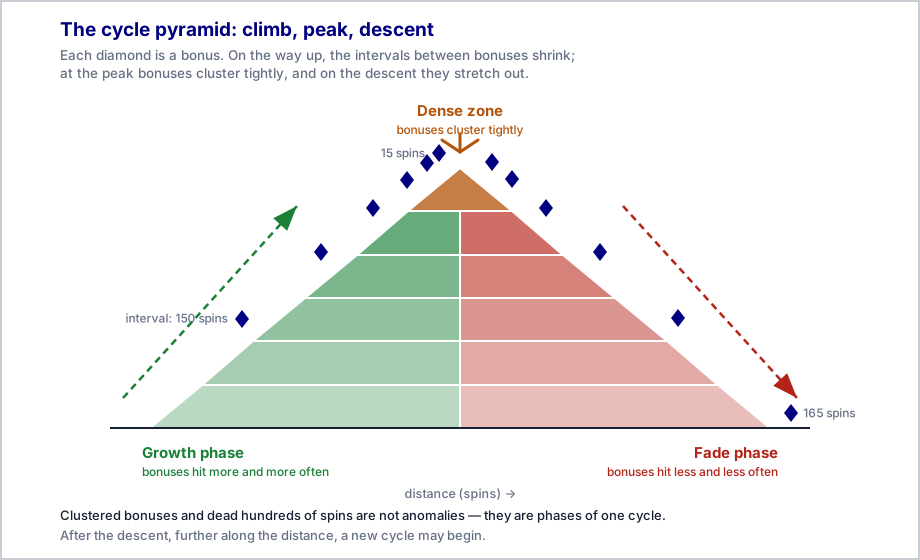
— Climb (growth phase) — distances between bonuses steadily shrink; bonuses arrive more and more often.
— Peak (dense zone) — intervals are minimal; bonuses cluster.
— Descent (decline phase) — distances steadily increase; bonuses drift farther apart.
Clusters of bonuses and “dead” stretches of hundreds of spins aren’t anomalies and aren’t “rigging” — they’re simply different phases of the same cycle. After the fade-out, over a longer distance, the cycle can start again. The pyramid’s shape varies by game: some slots show short, sharp cycles; others look flatter and more drawn out. It’s part of the game’s profile, and we capture it in our analyses.
Growth phase: bonuses come more often
The growth phase is the climb up the pyramid: each next bonus, on average, arrives closer than the previous one — up to the dense zone.
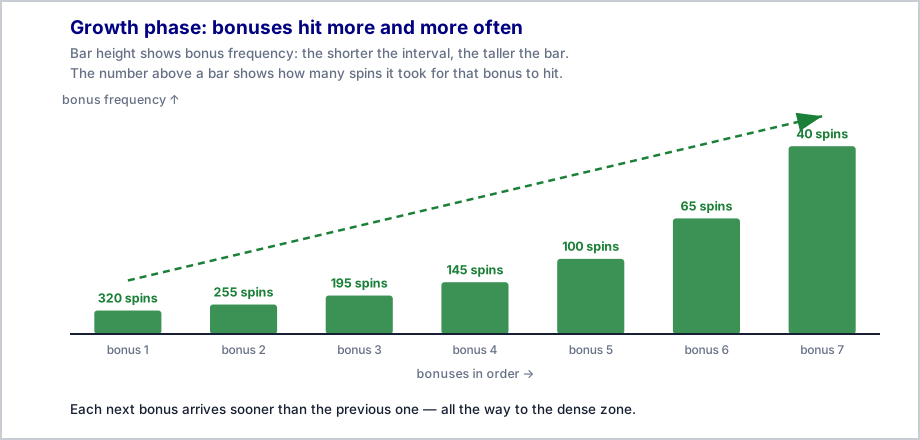
Phase markers:
— each next interval is shorter than, or comparable to, the previous one — a stable compression trend;
— bonus density over the segment is noticeably higher than the game’s long-run average;
— the phase appears after a dead patch — growth doesn’t start from the dense zone.
One important caveat: you only know where the rise “topped out” in hindsight. While intervals are compressing, you can’t know whether they will keep compressing — or whether the next interval will be the start of the stretch.
Decline phase: bonuses come less often
The decline phase is the descent: after the dense zone, intervals lengthen. A 50-spin gap becomes 150 spins, then 300+, and so on.
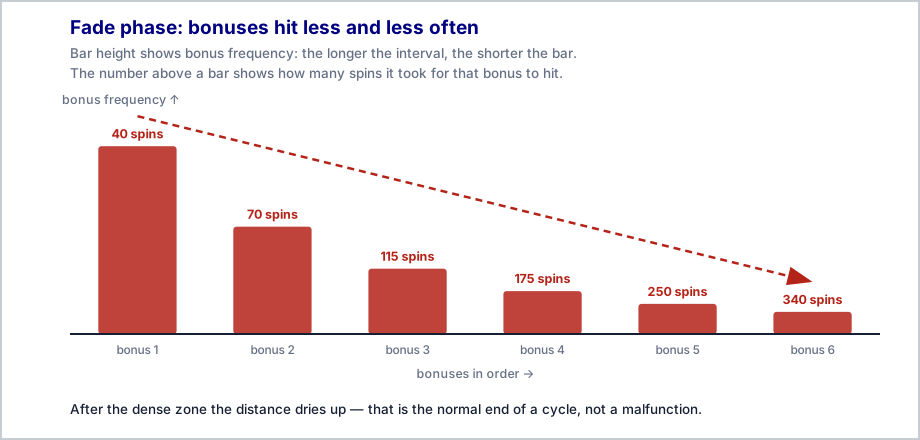
Phase markers:
— each next interval is longer than, or comparable to, the previous one — a stretching trend;
— bonus density over the segment is noticeably below the game’s average;
— the phase is preceded by a dense zone — the decline continues a completed cycle.
Those “dead” hundreds of spins in a row are a regular part of this phase, not a malfunction: the cycle is fading out, and that’s its normal ending. The decline also has a tricky special case — an active start followed by a fade-out: the false window — we cover it separately.
What these models can and can’t do
These models are description, not prediction. They help you see what phase a played segment was in, but they don’t tell you which spin will bring the next bonus — no one knows the specific outcome. The practical value is different: understanding that a slot moves in waves, reading your position in the cycle, and avoiding bankroll decisions driven by feelings — especially in the spots where intuition says “just a little more.”