
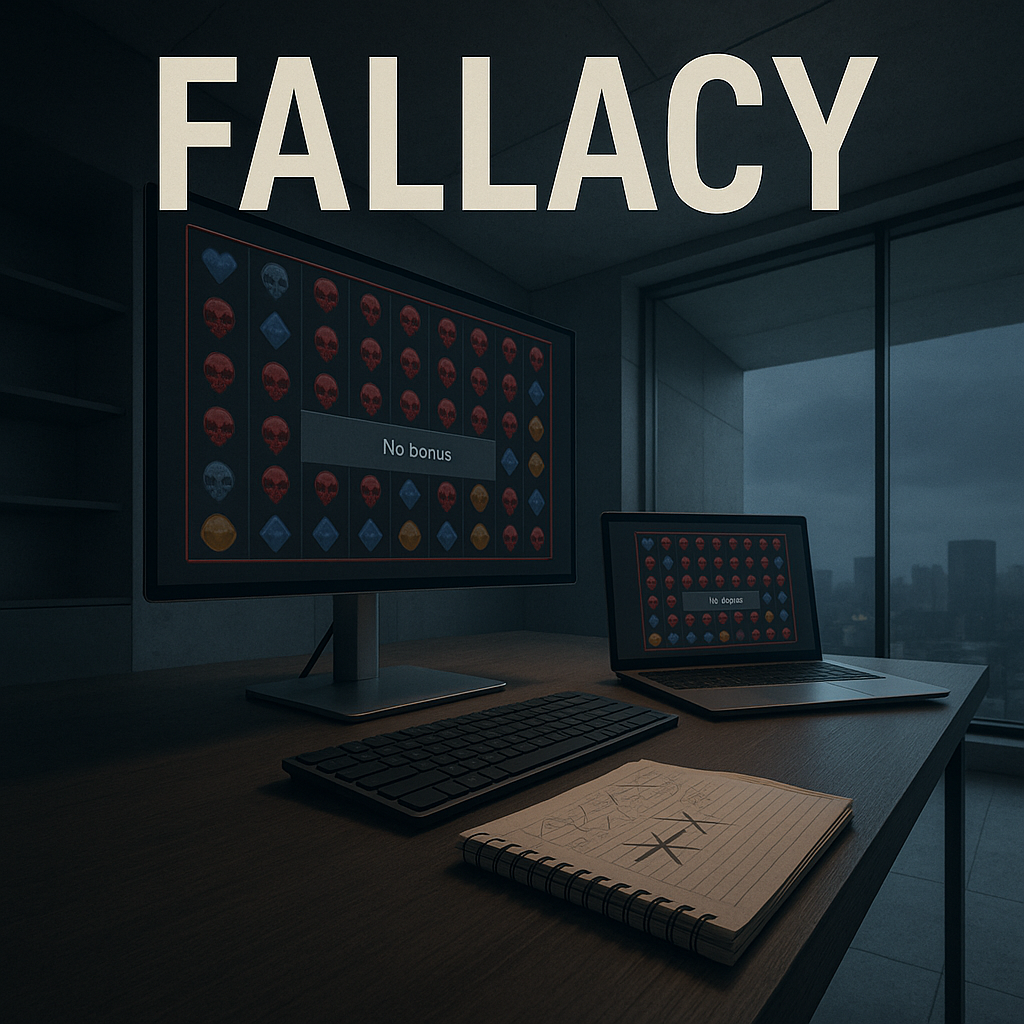
The Gambler's Fallacy: Why It Feels Like a Win Is 'Due'
The feeling that 'it's been a while, so it's due soon' is the gambler's fallacy. Spins are independent; a slot has no memory.
The gambler's fallacy is the belief that after a run of misses an event 'must' come. In slots it sounds like 'no bonus for ages — so it's about to hit'.
Why it's a fallacy
Each spin is independent: the RNG sets the outcome anew, ignoring the past. A slot has no memory and owes you no 'debt'. A run of 500 empty spins doesn't raise the chance of the next — the probability is the same.
Where the illusion comes from
The brain looks for patterns in randomness. It remembers the times a 'hunch' matched and forgets the rest. That's how a false sense of a signal forms where there is none.
What exists instead of 'due'
There's variance — the spread that makes randomness look like a pattern. And there's the distribution over distance: not 'it'll hit now' but 'where am I in the structure'. That's read from data, not from a feeling.
Bottom line
'It's due' is emotion, not a property of the game. Whoever sees the independence of spins doesn't pay for the illusion and decides on facts. That's the foundation of reading the system.