
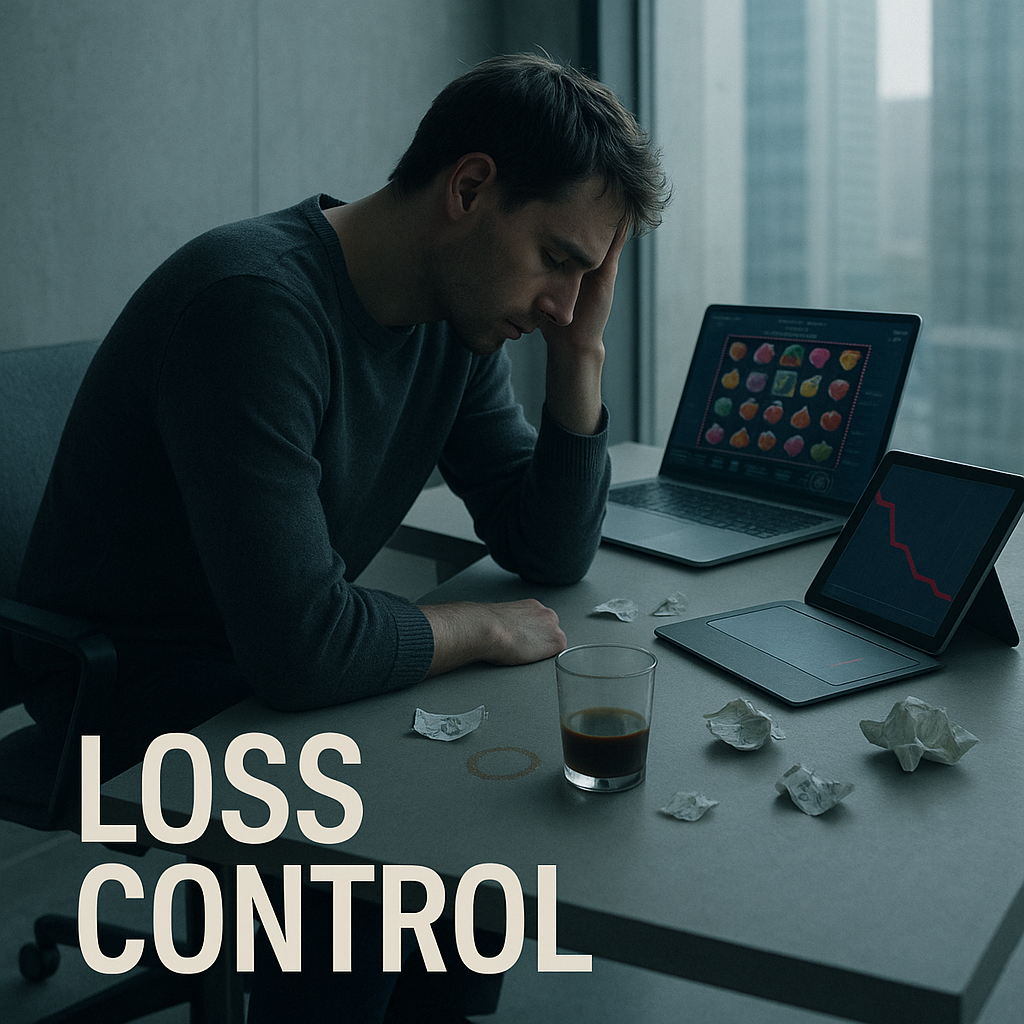
Burnout in Slots: Player Psychology and Loss of Control
Burnout on a single slot is an analytics failure. After it, decisions are made by state, not by data.
Burnout on a single slot is an analytics failure. After it, decisions are made by state, not by data.
Cognitive exhaustion
Long play on one slot (hundreds to thousands of spins) leads to cognitive exhaustion: concentration falls, working memory shrinks, the ability to track distance between events degrades. Neuroscience explains it through dopamine: the brain reacts more strongly to the anticipation of an event than to the result itself. That keeps a player engaged even without meaningful wins. A variable-reward system (Skinner) reinforces the behaviour, and the 'near-miss' effect makes the brain treat closeness to an event almost like the event.
The 'merging' effect
Over distance, a series of 300, 800, 1000+ spins stops being separate events and becomes one flow. Cognitive biases switch on: recency (the last spins feel more important), the illusion of control ('I feel the slot'), the gambler's fallacy (expecting that after a streak something must change). Resistance to recording appears: the brain simplifies the task and replaces data with sensations. Metrics — the distance between bonus games, their result, in-session RTP — stop being tracked. The line turns into noise.
Decision fatigue
After 1–2 hours, decision fatigue grows: self-control drops, impulsivity rises. A 'close the state' script appears: speed up, raise the bet, end the process. That's not the slot working — it's a reaction to overload. The player keeps spinning one slot, ignoring the decay of attention, substituting a feeling for analysis, confusing session length with 'closeness of an event'.
The conclusion
When you start playing consciously, the interest fades — and that's one of the first steps toward quitting. When data stops being recorded, there is no control. In that state the game is already over.
Sources (for the mechanics): Schultz W. (1997) on dopamine and reward anticipation; Skinner B.F. on variable reinforcement; Clark L. et al. (2009) on the near-miss effect; Baumeister R. on ego depletion and decision fatigue; Langer E. on the illusion of control.