
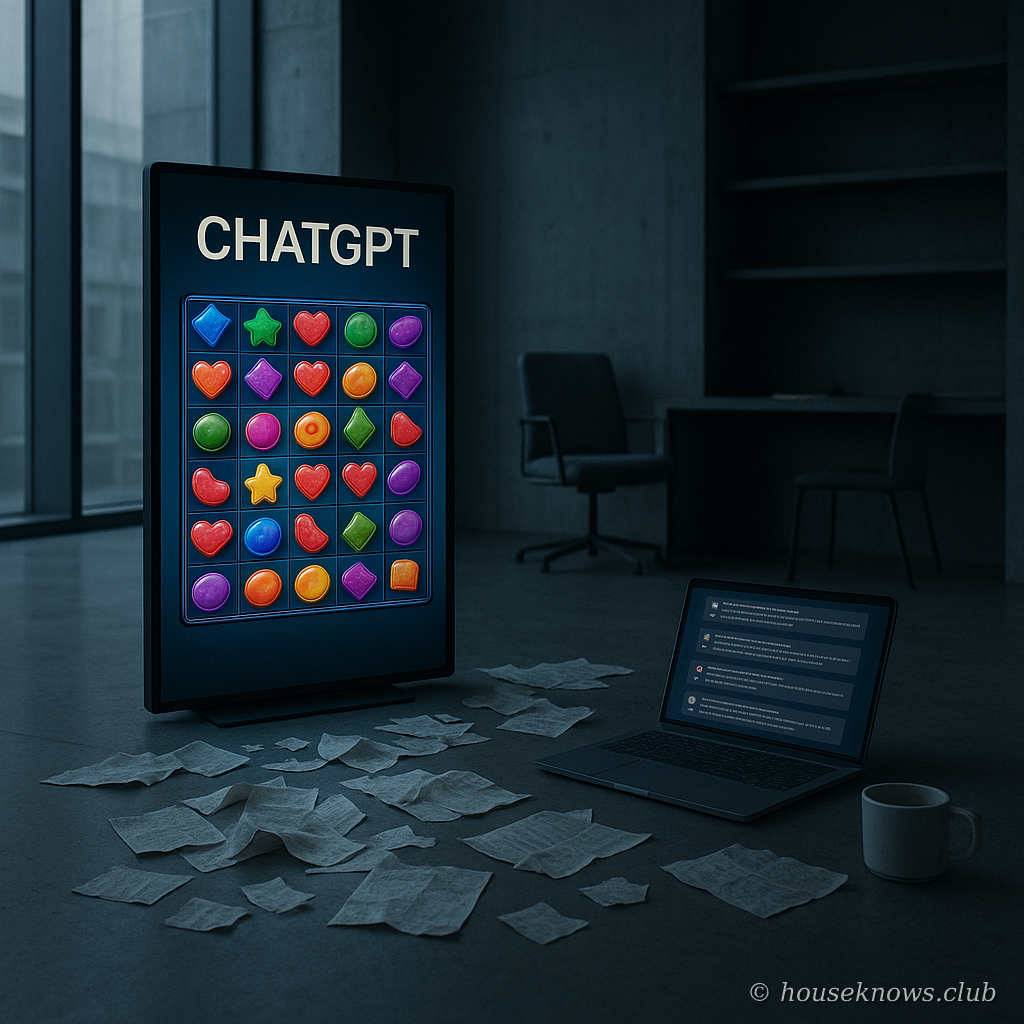
Why ChatGPT Isn’t Much Help for Online Casino Analysis
“I’ll upload my betting history to ChatGPT and it’ll find patterns for me.” Sounds reasonable—until you try it. In practice, it doesn’t crunch large datasets, falls back on generic slot reviews, and steers everything into “you can’t predict it.”
Why ChatGPT Isn’t Much Help for Online Casino Analysis
It sounds like a perfect plan: “I’ll upload my spin history to ChatGPT, ask it to spot patterns, and it’ll do the math.” In real use, that’s not what happens. The problem isn’t that there’s nothing to analyze—it’s how a chat-bot is built. Let’s be blunt about it.
It doesn’t process big datasets—it skims them
When you hand a model a file with thousands of spins, it doesn’t sit down and compute it like a spreadsheet. It has a limited amount of information it can reliably hold at once, and it doesn’t execute row-by-row calculations.
What it typically does is look at a slice of the data and respond with “it seems like…”. That often produces numbers that sound believable—but aren’t actually derived from your dataset. Ask for a distribution, and you may get something nicely formatted, but not your result.
It’s trained on the internet’s “average” slot discourse
Slot content online is dominated by the same recycled templates: “RTP is X, volatility is medium, gamble responsibly.” That’s the material the model has absorbed.
So when you ask about a game’s structure, it gravitates toward generic averages and the safe conclusion: “prediction is impossible; the house always wins.” That isn’t analysis of your data—it’s a rephrasing of the default internet consensus you can find anywhere.
It defaults to disclaimers instead of mechanics
Chat-bots are deliberately tuned to add gambling disclaimers. That’s sensible in general. But if you’re trying to understand mechanics—how variance behaves, where bonus “windows” appear, or how RTP differs from dispersion—it doesn’t get you closer.
Instead of a breakdown, you get “it’s random” plus a promise like “I’ll process the data now,” which doesn’t actually lead to computed conclusions.
What this really damages
The most harmful outcome isn’t a wrong number. It’s that after a couple of these exchanges, people lose the motivation to dig in.
They walk away thinking, “it’s all random, there’s nothing to understand,” and stop. Yet there’s plenty you can learn—not to “beat” anything, but to understand what’s actually happening over meaningful distance.
How to treat gambling data properly
Game data only becomes useful when you:
- analyze your real histories, not averaged third-party reviews;
- look at ranges and windows, not a single mean value—bonus-heavy averages are misleading because bonuses arrive unevenly;
- stop chasing “the next spin prediction” and instead describe the structure honestly, without promises.
A general-purpose chat-bot won’t do this for you: it won’t truly compute your files, and it will pull you back to a generic “it can’t be predicted.” Real understanding comes from working with real data—this is exactly what HouseKnows does.